Featured

My First Blog Post

How to Play with Stacking Cups

Be yourself; Everyone else is already taken.

— Oscar Wilde.

There are many ways you can play with the stacking cups. For my first blog post I will give you tips on how to play your child develop the skill of stacking and making it fun. Stacking is like building with blocks though they fit according to size. The different colours show a pattern though I think this gives it away- if the cups were all the same colour it would highlight the different cup sizes more clearly.

I can imagine it would be an interesting experiment if I could purchase 7 more sets of stacking cups. I could then make a yellow stacking tower, a blue one, a green one and a red one. And perhaps make different other patterns and combinations too.

You could hide objects under random cups and explore which objects according to size and quantity would fit under each cup. This is a good way to develop object permanence too. You could compare capacity using sand or water or any other materials- you could compare those too or mix the materials together for different outcomes. For example, sand mixed with water. This is the more obvious example though I’m sure you can think other others.

You could find and collect things which could be used to make your own stacking cups. You could ask questions such as, ‘Why does the base have to be a circle? Why not a square or a triangle or a star?” In fact, if you stack triangles of the same size you get a triangular prism, and if you stack circles you get a cylinder, and so on. Pulling apart and putting together 3 dimensional objects in different ways lays the foundation for future more abstract mathematical work such as working out math formulas and measuring.

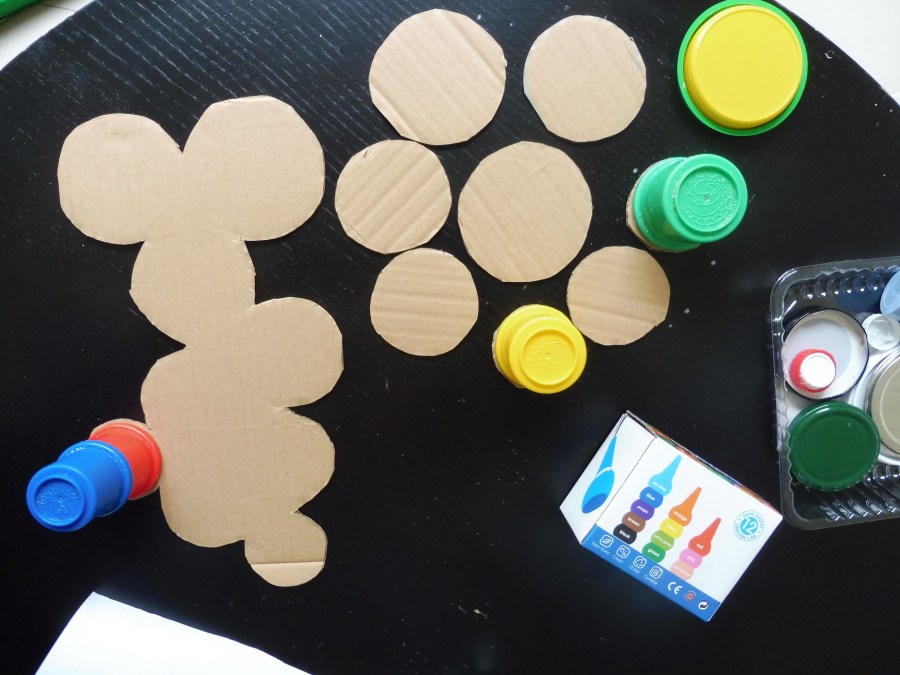
You could create art activities by tracing each stacking cup on paper or card. Cut and glue the circles to make a collage. Colour, paint or use different coloured paper. I make a matching game, much like a puzzle. You could also fold and cut each circle in half and make a collage of half circles. Using play through art and craft allows me personally to relax and enjoy trying out different ways of doing things. I can then show what I have learnt to children with more confidence and enthusiasm because I discovered it myself. Children can also make discoveries and show me in the same way. Play develops an exciting exchange of ideas! You can also use box construction material which are packaging such as egg cartons, boxes, rolls, and bottles. Watch the video for details!

Investigating the stacking cups in various ways lends itself to learning about different mathematical concepts such as circumference of a circle, measurement, sequencing size, counting, capacity, patterns, fractions and more! Once you learn to notice these concepts through play you can then use the language as you talk about what you are doing to highlight them. For example. You could point and trace the circumference of two different sized cups and say, ‘The circumference of this circle is bigger than the red one.’ And you may then ask,’why?’

If you child has the language skills to answer to not, that’s okay, in my opinion because I could then go ahead and model investigating and finding out the answer. And the great thing about this is that there are different ways of getting the same answer! This creates a quality learning experience for you and your child and you will also be able to extend the play experience to set these learning goals.

Using mathematical terminology during play, in my opinion is okay too. It’s a safe play to do so and it gets the child used to hearing it when they are having fun. So when they do formal math at school and hear those ‘big alien terminology’, they won’t get scared by it and get blocked from further learning- like I did at school.

Stacking cups fit like lids and I replicate this idea by matching them to fit the cups. Hands on experiences like this develop the child’s visual perception and their senses. This is so important to learn other mathematical concepts later on! If you’re interested, do a search on the internet for Montessori’s Pink Pyramid. This is a set of pink cubed blocks that also lays important foundation for further math, including mass.

Wouldn’t it be nice if all learning at school was hands on? There is a point when children get to a stage where they work with abstract math concepts- this is fine- this can be exciting too especially when you start working with patterns and bigger numbers- though if they haven’t had enough exposure to the 3D hands on learning they would be completely lost later on. In my opinion, play is a sophisticated way of learning so it’s appropriate for all ages- including adults like me! Emotional, physical and mental are just 3 of the endless benefits of play.

The overall aim of these play experiences is to make a model, and have a lot of fun using our creativity and imagination along the way. Many people tell me they aren’t creative or talented – I personally think this is because they may not have had the chance and time to play. The word ‘creativity’ can be a scary word too because not all people are seen to be creative- but I believe that everyone can be creative if they play!

So the process is the most important- not the end product because the process is when most of the learning takes place. This is also a time when mistakes are okay, and in fact better than okay because they may allow for other discoveries too.

Playing with your child has many benefits though the main one for me is developing a good relationship. Play allows you to spend time together and learn a lot about each other too. It creates life long memories your child will look back on. So if you’re like me, I love taking photos every now and then.

Featured

All About Me

Learn how to play with your child at home and choose quality educational toys. Blend the toys together to create awesome combinations and creations. Same money and time – I teach you what to look for in a good toy. 🙂

Come and have a play date with Maria!

I believe that less is more.

It’s what you do with the toys that’s important and how you play- HAVE FUN! Plus learn to watch for all the endless educational benefits of your spontaneous play experiences with your child(ren).

I started a series of videos to motivate myself and reflect on my stay at home mum job. I also missed teaching and sharing ideas with others. Bub appreciates my efforts 😉 and I achieved my main goal so far- to have fun playing as much as we can.

You can find these videos on my Youtube channel and Facebook ‘Maria’s Playground’.

I believe I am the best person to teach my child, and I don’t want to miss out on all the exciting milestones. These are also wonderful irreplaceable experiences and a lifetime of memories. This to me is the greatest reward – and the most important job in the world!

Before I became a mummy I was a teacher to some great kids and taught with some wonderful teachers. I studied a lot- some of these courses were Montessori, Early Childhood Education, Music, Twice Exceptional Giftedness, Special Education, and have had over 20 years teaching in different places of the world including Australia- where I now live. I believe that my home life which was rich in play was what motivated me do continue being creative and using my imagination to still play.

I also enjoy creating songs, stories, dance, games, editing movies and lots of other things. I love play because it opens up ENDLESS opportunities. Plus, in my late forties it keeps me feeling forever young 😉 So join me if you can in my world of play.

Why do this?

So instead of being that shy little girl who confirmed I’m excited to have this platform to express myself and showcase my work. I’m a people person and enjoy talking with people who have similar aspirations. Though in the past I haven’t grasped hold of my big dream. Although I’ve enjoyed the journey getting there I’d like to finally achieve it before I am too old to enjoy it.

If you’re a parent, teacher, student or anyone working with children or you’d also like to reflect on your childhood I’d like to hear your thoughts too. It’s important to me that I connect with others. I don’t specifically remember what I did at a child – I only recall what gave me joy. My students who are now adults tell me my classes were fun. Play is a gift that comes in many forms and it’s for all ages!

As parents we can play a big part of our children’s future. So often I’ve heard parents push for the academics. Play can provide a more holistic approach to education which means children get a bigger picture of the world which is hands on- at their reach and they can develop their own ideas. They can explore answers to questions and with a lot more scope for key learning than sitting amd listening to a teacher who stands at the front of the class feeding knowledge. This often doesn’t sink in because not every child is interested. I was one if them- I drifted off on a day dream while the teacher thought I was being a good girl. Through play children follow their interests and they enjoy learning. I was more myself at home. Not that I hated school – I just didn’t have the same opportunities.

At school I enjoyed the extra- curricular activities such as art, dance, music and sport. But this made up just a small percentage of what was taught. I also enjoyed handwriting and mapping and the other academics but these can also be integrated into these extra-curricular subjects .

I’ve written many other blogs but have hidden behind the achievements of others and helped them along. This time I hope I can have the courage to shine.

I hope that the every day play experiences with my child will grow and form into the topics I will write about on my blog.

I hope to connect with people who are like-minded.

Within the next year I hope to have started up something that I’ve always dreamt I would do but the timing was never right.

I’ve reach some of my dreams. I’ve written dozens of poems for adults and children. It was a period of frenzy- I couldn’t stop even if I wanted to. It was like my soul took over. I published a few books too. Play was what inspired me. Through my childhood I spent a lot of time alone day dreaming and playing. Sometimes with my brothers too. We had a big yard and a trampoline. We ran around and played all day.

We pretended to be protagonists and acted out scenes we watched on TV like Doctor Who. It scared me and interested me at the same time, and play was a safe way to explore my feelings.

So for my next personal project I’d like to illustrate my own picture books for children. I got others to do this and although I appreciate their help, they didn’t quite capture what was in my head. The beauty of imagination is that it’s yours. Like a personal signature and it’s extraordinarily fun! Where would childhood be without play?

Australian Animals and Nature Play Toddler at Moonlit Sanctuary Melbourne Australia

It’s important to me that my child spends adequate time outdoors in nature each day. It doesn’t always work out that way so when we go on an outing we make the most of our time.

As bub gets older I feel more comfortable stretching the time outdoors. It’s not a hard thing to do because time goes so quickly with such an action packed day.

Toddlers love to move in different ways; they run, walk, jump, balance, and there’s so much space here to do all of that and more. They use their senses to hear the animal sounds, the sound their feet make as they stomp in the mud and the way this feel. They balance on logs and walk through trees and pieces of wood.

There’s a playground of different animals such as a snake, a crocodile and a turtle. I watched as the children tried to climb the turtle, showing each other how and eventually achieving this goal, and applauding one another.

The video is a tool I use to reflect on this experience with my child, and to further her learning. As she gets older I hope she will gain more and more from it.

The letters are colour coded; blue for vowels and pink for consonants. This is a Montessori teaching Method which makes the words easier to learn.

Children can learn the animal names which are so interesting. Imagine drawing an animal such as the Tawney Frogmouth! The texture on this animal actually looks like a rock. Perhaps this helps camouflage and protect the animal from predators as it sleeps.

Watching the kangaroos were my favourite. The way they were standing so still amongst the sticks, and suddenly hopping away. Just like they would in the wild. Which animal was your favourite? Children could build with the sticks at a separate area and imitate the animals as they play.

An experience that will leave a long lasting imprint in the mind. It was wonderful to see my bub wasn’t afraid of the animals. I feel that it’s important to have contact with nature as early as possible.

What kind of outings do you do with your family? What are some of the experiences you’d like to offer your children and why are they important to you?

A Toddler’s Day Out Bird Watching & Nature Play

We were lucky because on our first visit to Grant’s picnic ground in Victoria there was no bird feeding and this attracted more diverse Australian birds, especially Lorikeets. Lyre birds also live here but are harder to spot. I was told they imitate the sounds of other birds.

This was an opportunity for my bub to experience the bird life and not be scared by the sounds they make. They can sound quite prehistoric; have you ever noticed that? It was also a chance for me to try out my new Nikon P1000 camera and its amazing zoom capacity. Bub tried it too.

I believe children learn the most from their parents. We are like one person as bub tries to imitate everything I do and say. They then develop the ability to interact with others. That’s nice to watch too. 🙂

The most fun was when bub explored the open space on her own and I watched her. It’s so important to know when to intervene and allow bub independence and opportunities to problem solve safely. Nature provides this because it isn’t designed for a certain age group like man made playgrounds. It’s for everyone. It builds self-confidence as bub tries again and again and is finally successful.

Properly fitted shoes are so important in these situations where bub is running, climbing and doing all kinds of physical activities for a long period of time. We spent 3 hours at the park! Get the proper size shoe fitted at a sports store or child’s shoe store specialising in this, is what I recommend. Or if the weather is warm and it’s safe to do so go bare foot.

Oh the possibilities nature has to offer. We don’t need to make anything up. It’s right there for us to explore. The textures and colours of vegetation, the size of the trees and their life cycle. Some have fallen over, others are just babies. The language opportunities as we talked about everything.

I talk in both Greek and English, and this preserves my mother tongue as well as giving my bub the chance to extend her languages. It’s so liberating to be outdoors and to feel what it’s like to be in nature. To breathe in oxygen and to sense the cold air around us.

Go regularly to sense different seasons and weather changes, and how this affects nature. Watch the sun come out through the trees and the rain drops fall and glow on the leaves.

Australia has so many different environments to explore. What’s it like where you live? It’s so different to watching nature on film or reading about it. I encourage you to do what we did. Just go unplanned and explore. Just prepare food and water. I prepare a lot more than what I think I’d need. I also leave a portion of it in the car for the long drive home afterwards.

Beautiful Montessori Inspired Lessons for 3-6 Year old Children

At one stage of my career I started created lots of educational materials. It all began when I learned about Montessori Principles of Teaching through the courses I studied via UK and USA. I was so inspired by these. They were like a magical recipe I could use to create lessons that clearly taught concepts and skills.

I collected things, bought various things with a plan in mind. I designed my own original ideas as well as extensions and variations. I’ll presume you know what this means and move on with my post. But if you would like to know more, feel free to type in a comment below.

I spent hours every day making materials. All kinds. I created games, designed lessons and activities. It was all very exciting. Until of course I had to move and wasn’t able to take everything with me. But I have photos and drawings of what I planned to make too. I hope that in the future I will use these drawings to do just that, and develop more ideas.

Lately I’m interested in nature and how valuable this is; especially for young children. Nature is the best place to learn and grow. With so many possibilities I will post some ideas as part of my next video series. Using nature to inspire lessons in the classroom is another way of inspiring children’s learning. I find that after a few days outdoors I only have to strategically place samples of what’s found outside such as sticks, leaves, shells, stones, and my child is drawn to these. It brings back to life the experiences she had.

Montessori inspired hand made materials created for my work with children aged 3-6 years. It’s important that learning goals are clear and the materials are beautiful so the child respects them.

The materials I prepared in this video teach Math concepts and prepares the child for reading. Indirect learning is what interests me the most because it provides lessons and activities developmentally appropriate for individual needs and interests.

If you’d like to know more or have ideas of your own to share on the topic feel free to comment in the box below.

Thank you

Painting and Messy Play for Toddlers & Preschoolers

One fine sunny day I decided to take out different coloured paints, some paper, brushes to paint. As most kids do, we started exploring the paint using our hands. I took the paper away and hung it to dry and added water to the mixture which covered the tray. At this point, I thought it fitting to add the flour. This was when the real fun began!

We started making squiggles, squeezing the mixture with our hands as we watched the colours and textures mix. We each took a brush and chatted away as we explored. It was relaxing.

A plastic breakfast tray is ideal for messy play because you could take it anywhere and it’s fuss free to clean up afterwards. If you want to preserve a painting just pop a piece of paper on top of the mixture to create a print.

Use what you have and mix in the colours, create different textures as you go along. Sand, flour, flowers, chalk and leaves are some ideas. Try different things. Look in your environment for new ideas.

Using hands and utensils is wonderful for sensorial and hand strength and coordination! It’s so therapeutic. As we played, our minds wondered.

The messier the better. Process is more important than the product. Take lots of photos of the play experience and talk about them afterwards. What patterns and marks did you make? What colours? How did you feel?

Each time we visit this activity it’s different. The weather, the materials we use, and what we feel like doing. Talk through your plan and ask questions like, ‘What do you want to do now?’ to foster decision-making skills.

Messy play fosters confidence and creativity. The end of the activity is just as fun. As I rinse the tray with the hose we can see all the colours. Subject areas such as Maths, Language and Science can be integrated too.

I believe we can create hands on activities that teach the academics in a fun, age appropriate way that also provides more scope for learning. Take a look at my other posts on my blog for more play ideas and subscribe to my Youtube Channel Maria’s Playground.

Thank you! And keep on playing!

How to Make An Origami Kite

My father showed me how to make this origami kite as a child. I sometimes wonder who showed him. I guess I’ll never know because I didn’t get a chance to ask him.

I think it must be one of it’s kind and it works! As children our kites flew high into the sky- way up high- it was amazing! We used pad paper and cotton. Dad didn’t use scissors. This was a luxury when he was a child. He tore instead.

I haven’t flown a kite in a while and I’m not sure why. We flew kites all the time as kids. It doesn’t take much wind to whisk it up into the air! I wish dad was here- it’s not the same without him and life is so different now. So this kite is something of him I keep. In my mind I’m flying it and he is with me.

The video takes you step by step on how to make it with pictures. Pause where you need to. The man at the end flying the kite is my brother. We had to put our heads together and try to figure it out.

Are there any games or toys you played as a child? Any find memories of your parents? Your grandparents? How do you hold onto those?

For more play dates subscribe to my Youtube channel and for more information and to make comments follow my blog https://playdatewithmaria.music.blog/

Lifecycle of A Green Sea Turtle

During my teaching days I remember how useful videos such as this one were. I could set it up the night before and students would be attentive and intrigued that their teacher created it. I used it as a model for older students to create their own.

Quizzes are a great way to entice interest in a topic. It also teaches how to ask questions. Developing responsible and useful ways to use computer technology is important.

You could use the video with a book about sea turtles. Pause the video after each question and find out the answer in the book. This is one example on how parents and teachers can use this video as a teaching tool.

After watching the video, set up a sand box and a cup of water with figurines of the lifecycle of a Turtle for children to act out the turtle’s story. Write it down or film it.

Adapt to the child’s interest and level.

I created this video because I find turtles interesting. They are mysterious creatures and it seems there is a lot more we can learn about them.

Years ago I taught a Grade 3 class and I entered my class into a Turtle naming contest. A real live one! Turtles are tracked by scientists to protect them and learn more about them. Ours was one of the winners and the turtle’s name we thought of was ZIG ZAG. I sometimes wonder how ZIG ZAG is.

For more play dates subscribe to my Youtube channel and for more information and to make comments follow my blog https://playdatewithmaria.music.blog/

Quick & Easy Play Ideas for Toddlers and Beyond

Quick and easy tips on how to combine the toys you have and every day things to create educational outcomes through simple play experiences. Perfect for toddlers and pre-schoolers. Perfect for busy stay home parents or working parents who just want to do some fun activities at home.

Adapt the activities to your child’s level. These can be repeated every day as your child learns different concepts each time the activities are visited. Focus on a different sense each time- for example, hear how each item rolls. Can you guess which object it might be? Close your eyes- how do they feel? How heavy are they? Possibilities are endless though here’s a place to start.

I show you how to set up your toys at home in an inviting way and to help your child learn. I also create activity sets which teach matching pairs, how things move, simple experiments, connecting ideas and learning new skills. Counting practice in different ways! We explore the relationship of matching pairs, and the idea of odd and even. Explore how different shapes are made by building, and how they move. E.g. A cylinder can roll. Share items with a friend. Find the relationship with sharing and adding!

What do 5 things look like?

Explore, explore, explore and have fun!

Try to keep this as verbal as possible. Lots of talking and pause at different words and repeat them. You could do some writing a different time such as chalk drawing squiggles. For older children write the numbers up to 5. Though do go back and do the hands on activities a lot more. Try to think of ways to extend your child using what you have- go outside and revisit the activities again finding other matching pairs found outdoors.

– Mix and match lego and blocks. – Dress up your teddy bear.

Transport things from one place to another.

Sensorial boxes of all kinds and add a magnifying glass

A breakfast tray or a small trampoline outside to use as an activity table.

Pre-trace a puzzle to colour or paint. Later create a book.

Lay parts of a puzzle to create a play experience. Use a cardboard box and change it to anything you like. This is called symbolic play.

Hide toys and find them again.

Watch the video for more ideas. I like to write ideas on a pieces of paper and post it on my fridge. Single words to cue me in over the course of the busy day.

If you’re like me, you might like to start journal or a blog. Do it and let’s connect, share ideas and build a better education in the home for our children.

For more play dates subscribe to my Youtube channel and for more information and to make comments or ask questions please do so below. And you can also follow my blog: https://playdatewithmaria.music.blog/

Play Experiments on How Things Roll for Toddlers & Pre-schoolers

A simple experiment that can last all morning. Combine play dough to stick parts together. Toddlers love this play experience.

A folded up gym mat or anything that makes a slat works for this exciting play experience. Collect different sized balls, lids, cylinder blocks and containers and simply let them go from the top to watch them roll down.

A wooden toy car or truck that shows the wheels and how they are made is displayed for reference. Try rolling it too. Let’s now make our own wheels!

The lids are too thin and so we stick two together to make it roll better. Watch the shape of makes as it rolls. This isn’t shown in the video but you could roll the lids in paint to visually see the patterns better. Using play dough is a great way to introduce sticking without glue.

Try sticking the lids into different blocks and roll. What happens? This is really great fun and your child will learn a lot. He/she will gain confidence by leading his/her own play. Your child will then be telling you what to do.

Which shapes cannot roll? How can we change shapes to make them roll? These are great problem solving skills.

I recommend using what you have. Often we worry too much about this and it becomes an obstacle. Collect containers and other useful materials. Involve your child with making the play dough.

I hope you enjoy this activity. Which part do you like most? If you do try it I’d love to hear how it went.

Thank you for watching.

How Lego Teaches Maths

Playing with lego is fun and these large ones are great for developing toddler’s fine motor and gross motor skills as they learn.

Today I demonstrate how to use lego to teach Maths. Before starting I sort the lego pieces into size and colour. This makes it easy to see what I have, and get to know the dimensions of each piece. We can use these pieces to compare, count and measure.

By familiarising themselves with the dimensions, children can build and design different structures. They compare lengths, add and subtract, and count on. They estimate and test which pieces may or may not fit. Using knowledge such as symmetry they can build stronger structures. They learn about fractions, exploring halves. They count. The skills are endless as they enjoy creating!

Children learn to control their movements, hand-eye coordination, visual perception, and other skills needed for building. They practice crossing the midline, pincer needed for writing, gross motor and fine motor skills. Thinking skills, problem solving skills, imagining, planning, preparing, visualising, and sorting.

The many skills that lego teaches!

Sorting, counting, comparing lengths, comparative language, colours, size, construction, adding and subtracting, making a strong base and building, exploring change, shapes, less and more, perspective, visualisation, hand-eye coordination, hand strength, concentration, and pincer finger hold (this is what’s needed to hold a pencil later on).

Am I missing anything else?

As a Montessori trained teacher I used Montessori principles in this play based lesson. For toddlers, I model doing it and at any time the child can take over. Older students can play side by side creating their own designs.

Avoid going to pencil and paper. If you need a record of the child’s work, take photos or a video. Tablets are a great way to do this then when the child is ready he/she could create a video to illustrate his/her own learning.

Written extensions include tracing the lego or drawing the pieces. Include a ruler and/or draw on graphed paper. Or blank paper with a free hand. Create the addition concepts, make the shapes and colour the patterns. Keep it open ended and this will serve itself as a an activity appropriate for different levels.

Keep it fun.

Translate this over to using blocks and other types of construction material.

If you do try This, I’d love to hear how you went with it. Leave a comment below. Thanks!

How to Make A Felt Alphabet Learn and Play Montessori Inspired

The letters in the video are Victorian cursive and you could use what you like. I’ve integrated hands on play based ways to use the alphabet. The felt gives a sensorial experience which helps remember letter formation and sounds as the child traces each letter and says the sound.

I’ve used Montessori principles to create activities/lessons that can inspire story creation through play. Use the toys you have and add to the collection as your child shows interest. It’s a fun way to categorise things around him/her. Later you could use pictures and write words though I stay hands on for as long as the child is interested. Don’t rush into the abstract too soon.

Use this for the letter of the day and locate where it is on the alphabet. Use different combinations and order of letters. What you choose to do depends on learning goals and the child’s interest. Follow where this leads your child and adapt it to his/her level.

Use this in association with Montessori moveable alphabet or a different set. Try magnets and place the alphabet on a magnetic board. I believe that children need to be exposed to different kinds of print and capital letters. You could also match capitals with lower case letters. Focus on letter sound not the name to avoid confusion. Once the child knows the sounds he/she can blend words and then introduce the letter names. The possibilities are endless. You can use this for any age.

If you have any questions you can comment here or find Maria’s Playground on Facebook. My website is coming soon too. Click the like button and subscribe if you would like to see more if these videos.